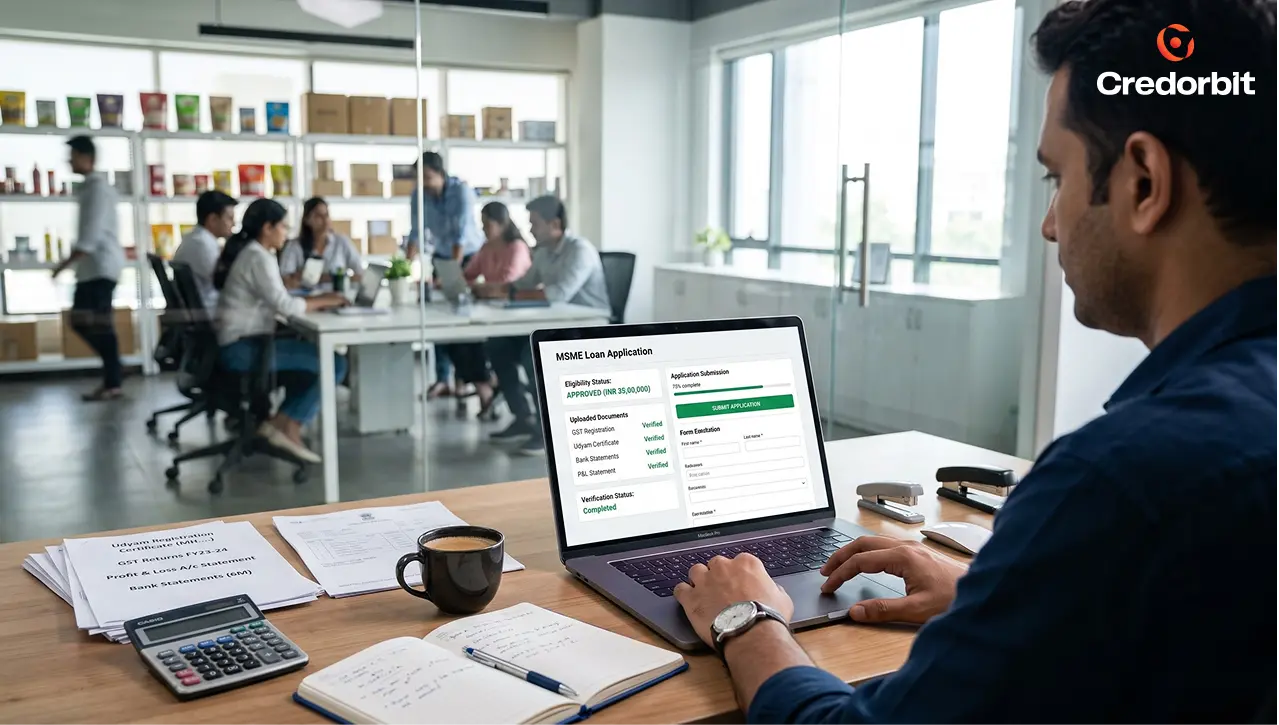
It’s exciting starting and expanding a business; however, sometimes finding the money that you need, when you need it, can be a real battle. Whether you need working capital to manage your running costs, fund stock or inventory, finance equipment or machinery, or to support the growth of your business, getting hold of the right amounts of working capital can often prove problematic for businesses. Business owners also frequently find that the loan application process, the need for collateral, and a vast amount of paperwork are obstacles.
This is where MSME loans come into the picture. Made exclusively for micro, small, and medium enterprises, these loans facilitate capital to businesses through various lenders, ranging from banks to NBFCs and various government schemes. To apply for MSME loans online, it is no longer a task; with the ease of the Credorbit digital interface, the application and documentation can be done online, and businesses can get in touch with potential lenders online. Even though the eligibility criteria, interest rates, and collateral requirements differ across lending partners and every MSME loan scheme, awareness of the lending process helps businesses in making sound financial decisions.
In this guide, we'll cover everything you need to know about MSME business loans, including eligibility, required documents, interest rates, popular government schemes, and the online application process.
What Is an MSME Loan and Why Does It Matter?
An MSME loan refers to business loans for Micro, Small and Medium enterprises that cater to their business operations and growth needs. Companies can take MSME loans for working capital, procuring machinery, purchasing equipment, building infrastructure, managing inventory, technology advancement, and company expansion.
Timing and flexibility of funds often distinguish success from missed opportunity for many business owners. An adequate business loan for MSMEs can empower the organization by keeping the cash flow smooth, facilitating investments to enhance productivity, and enabling the firm to quickly capitalize on the changing market needs without hampering its existing workflow.
The types of loans a business can opt for can be dependent on the lender, but some include unsecured and secured loans, short-term working capital loans, loans for buying machinery, or any specific government MSME loan schemes for various benefits.
Types of MSME Loan Schemes Available in India
Businesses can choose from several financing options depending on their funding requirements. The trend of MSME business loans is becoming more prevalent, and several providers are now offering loans with zero collateral requirements, where a lender offers an unsecured loan on the basis of a business's income, revenue, and credit profile.
- Working Capital Loans: : These loans help businesses meet everyday expenses such as staff paychecks, shop rental fees, the costs of products sold, utilities, and payments owed to suppliers. These loans can be particularly helpful at the height of consumer demand or if clients themselves have fallen behind in their payments.
- Term Loans: When you need funds for long-term purposes like business expansion, starting new plant/office, purchasing machinery, tech up-gradation or property, a term loan fits the bill. Here, the loan is repaid on a monthly basis over a fixed tenure.
- Unsecured MSME Loans: :Many lenders now offer unsecured MSME business loans, allowing businesses to borrow without pledging collateral. Approval is generally based on business performance, turnover, and creditworthiness.
Popular Government MSME Loan Schemes
The Government of India has launched several initiatives to improve small-business access to finance, including:
- Pradhan Mantri Mudra Yojana (PMMY): For micro and small businesses.
- CGTMSE: Supports collateral-free lending through credit guarantees.
- Stand-Up India Scheme: Supports women entrepreneurs and SC/ST business owners.
- SIDBI Programs: Help with technology upgrades, expansion, and business development.
Choosing the right government loan scheme for MSME depends on your business size, funding requirement, and eligibility.
See Also: How Indian Startups & MSMEs Can Raise Growth Capital
Eligibility Criteria and Documents Required for an MSME Loan
While each lender has its own requirements, most applicants must satisfy certain basic eligibility criteria.
Standard Eligibility
To apply for an MSME loan, businesses generally should:
- Be registered as a Micro, Small, or Medium Enterprise where applicable
- Operate as a proprietorship, partnership, LLP, or private limited company
- Meet the lender's minimum business vintage or turnover requirements
- Demonstrate stable business income and repayment capacity
- Maintain a satisfactory credit history
Meeting these criteria improves the chances of faster approval, although final eligibility depends on the lender and selected MSME loan scheme.
Documents Required
The documents required for MSME loan for new business or existing businesses may vary slightly, but commonly include:
- Aadhaar Card and PAN Card
- Address proof
- Business registration documents
- Udyam Registration where applicable
- GST registration documents if applicable
- Bank statements
- Income Tax Returns
- Profit & Loss Statement and Balance Sheet
- Business proof such as a Partnership Deed or Certificate of Incorporation
Keeping these documents ready before applying can significantly reduce processing time.
MSME Loan Interest Rates
One of the most searched questions, how much is the MSME loan interest rate? In India, it varies according to several elements, like; lender, loan amount, repayment period, nature of the business, borrower's profile, and the credit score of the borrower.
How to get the Indian Bank MSME loan interest rate?
When applying for an MSME loan from Indian banks, you might come across numerous offers and interest rates. Be mindful of the fact that every bank and financial institution (NBFCs, or even government schemes) will have varying interest rates. Instead of looking solely at the interest rates offered to choose a business loan, check all the details about the loan like processing fees, repayment period, flexibility, and eligibility requirements. To ensure you get better loan terms and conditions, keep a clean record of financial statements, submit tax returns and GST on time, and maintain good business stability.
Read More: How MSMEs Benefit from Fintech Innovations
How to Apply for MSME Loan Online
Applying for an MSME loan has become far simpler with digital lending platforms. Instead of visiting multiple branches, businesses can complete most of the process online.
The application process typically involves:
Step 1: Check Eligibility
Review your business profile, funding requirement, and financial records to determine the most suitable loan option.
Step 2: Submit Your Application
Complete the online application form and upload the required KYC, business, and financial documents.
Step 3: Verification and Credit Assessment
The lender evaluates your documents, repayment capacity, and credit profile before taking a lending decision.
Step 4: Loan Approval and Disbursement
Once approved, the loan is sanctioned and the funds are transferred according to the lender's process.
Digital applications have made the entire journey faster, more transparent, and easier for businesses seeking timely financing. Before applying, you can use a Loan EMI Calculator to estimate your monthly repayments and plan your finances more effectively
Common Reasons Why MSME Loan Applications Get Rejected
Even eligible businesses may face rejection if certain financial or documentation requirements are not met. Some of the most common reasons include:
- Low credit score or poor repayment history
- Incomplete or incorrect documentation
- Irregular business cash flow
- High existing debt obligations
- Inconsistent GST or tax filings
- Business turnover below lender requirements
Reviewing your financial profile before applying can improve your chances of approval and reduce unnecessary delays.
Why Apply for Your MSME Loan Through Credorbit?
Finding the right lender is often just as important as choosing the right loan. Credorbit simplifies the borrowing process by helping businesses assess financial readiness and complete applications digitally.
With Credorbit, businesses can:
- Check loan eligibility digitally
- Upload and manage documents securely
- Receive financial insights to improve lending readiness
- Connect with suitable lending partners
- Experience a faster and more transparent application journey
Apply in Just 3 Steps
- Check your eligibility
- Upload your documents securely
- Connect with suitable lending opportunities and complete your application
By reducing manual effort and streamlining documentation, Credorbit helps businesses focus on what matters most, growing their business.
Conclusion
Access to quick funds is of immense importance for all growing businesses, whether you need funds for your working capital management, buying new equipment, or expanding your business activities. Select the best MSME loan scheme that would cater to your business needs with utmost confidence.
Compare different schemes, read their eligibility criteria, collect all the documents required, and weigh down all the terms and conditions of the loan before you apply for an MSME loan, instead of just looking at the interest rates. Thanks to platforms like Credorbit, the entire MSME loan application process gets much easier with digital ease to allow businesses to get good visibility over finances and access various lenders with a streamlined experience